


I killed three batches of orchids before I figured out what I was doing wrong. Not because orchids are hard — they’re not — but because every guide I read gave me the same wrong advice: “just place it in water and mist the roots.” Nobody mentioned the 12-hour drying step, the exact water depth that separates success from root rot, or why Singapore’s humidity is actually an advantage for this method.
After two years of growing orchids in water at home, this is everything I wish I had known from day one.
Quick Answer: Place your orchid in a clear glass with 1–2 inches of water, keeping the upper roots exposed to air. Change the water every 5–7 days. Keep in bright indirect light — never direct sun. Works best with Phalaenopsis. Expect a 2–4 week adjustment period before new growth appears.
What Is Water Culture and Why Does It Work?
Water culture means growing your orchid with roots partially in water instead of bark or moss. For most plants this would cause rot. Orchids are different because they are epiphytes — in nature they grow attached to tree branches, with roots that experience brief saturation from rain followed by long periods of open air.
Water culture mimics exactly this cycle. According to the American Orchid Society, Phalaenopsis orchids adapt particularly well to this method because of their thick fleshy roots that store water between changes. This makes them the safest starting point for beginners.
My Experience
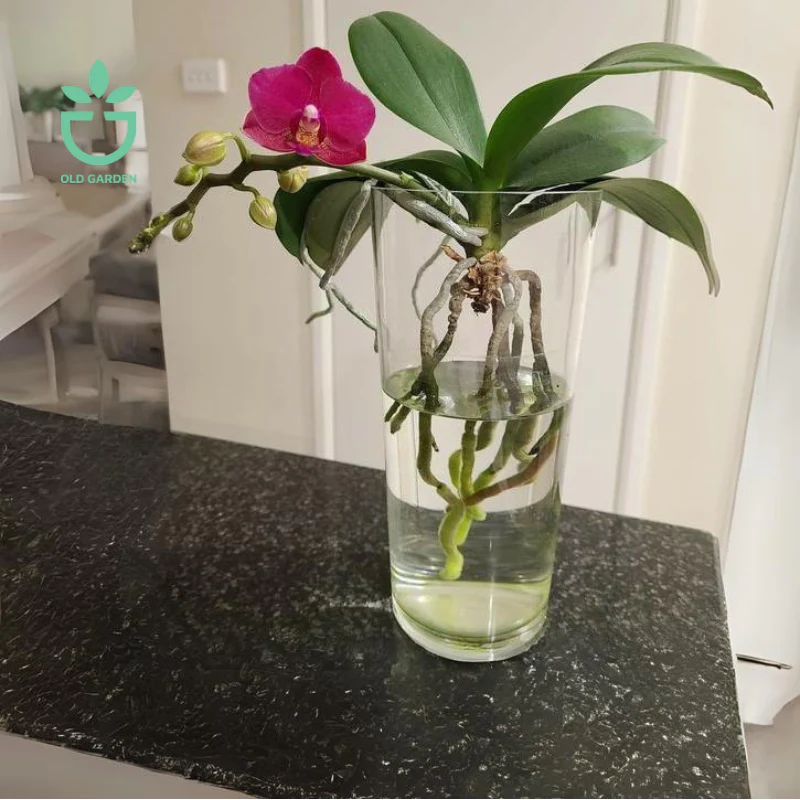
My first water culture orchid was a $12 supermarket Phalaenopsis — slightly root-bound, slightly sad. I cleaned off all the bark, cut two rotten roots, and put it in a tall glass with 1.5 inches of water. Three weeks later two bright fluorescent-green root tips had emerged from the base. Eight months after that it bloomed for 14 weeks straight. That one success made me switch every orchid I own to this method.
What You Need
A clear glass container. Transparency is not optional — you need to see the roots to know when to water. A tall straight vase works for large orchids. A wide-mouth mason jar works for smaller ones. Avoid coloured glass, ceramic, or anything opaque. A good tall clear glass vase makes monitoring roots effortless from day one.
Water. Tap water works in most homes. If your tap water is heavily chlorinated — common in parts of Singapore and Pakistan — let it sit uncovered for 24 hours before using, or switch to filtered water. I switched to filtered after noticing brown root tips developing, and the difference was immediate.
Liquid orchid fertilizer at quarter strength. Standard fertilizer burns roots in water culture. You need a hydroponic-grade formula diluted to one quarter of the recommended dose. MSU Orchid Fertilizer dissolves completely with no residue and is the one I use. Dyna-Gro Grow 7-9-5 is a more budget-friendly option that gives excellent results. Feed every third water change — not every change.
Optional: A full spectrum grow light if your space gets fewer than 4 hours of bright indirect light daily. A digital humidity meter is useful in heavily air-conditioned rooms where humidity drops below the 50% orchids need.
Step by Step: How to Switch Your Orchid to Water Culture
Step 1: Choose the Right Orchid
Phalaenopsis (Moth Orchid) is the best starting point — forgiving, widely available, and the fastest to adapt. Dendrobiums work well too but adapt more slowly. Avoid Cymbidiums entirely — they need a cool dormancy period that water culture cannot provide.
Step 2: Remove All Bark and Inspect the Roots
Remove your orchid from its pot and rinse every root under lukewarm running water until all bark, moss, and debris are gone. Then inspect:
- Firm, white or silvery-green roots are healthy — keep them
- Hollow, dry, brown roots are dead — trim with clean scissors
- Soft, dark, foul-smelling roots are rotten — cut back to healthy tissue
When in doubt, cut it out. One rotten root left in water culture will contaminate the entire container within days.
Step 3: Air Dry for 12 Hours — The Step Most Guides Skip
Before putting your orchid in water, lay it on a clean towel near a window for 12 to 24 hours. This lets fresh cuts callous over and closes the entry points where rot would otherwise start. It also begins the root’s adaptation from bark moisture to water.
This step feels unnecessary. It is not. The batches I lost before this step were all skipped for this reason.
Step 4: Set Up Your Container
Fill your container with room-temperature water to a depth of 1 to 2 inches. This is the single most important measurement in the entire method:
The upper roots must remain in air. Always.
The lower third to half of the root system sits in water. The rest is exposed. This air contact prevents anaerobic rot and is what separates successful water culture from a drowned orchid. Position the plant so the base of the stem sits just above the water line, using a thin stake or the container walls for support.
For general principles on setting up any indoor plant correctly, our guide on 10 secrets to thriving indoor plants covers the foundational care habits that apply here too.
Step 5: Wait Through the Adjustment Period
For the first 2 to 4 weeks nothing visible happens. This is normal. The plant is growing new water-adapted roots internally and adjusting its water uptake system. It may drop a lower leaf or two.
The signal that the adjustment is complete: a new root tip — bright fluorescent green — pushing out from the base. Once you see that, the plant has adapted successfully.
If you see a mushy base, foul smell, or roots turning uniformly brown and soft: remove the orchid, cut all affected tissue, air dry 24 hours, and start again with fresh water. This is recoverable if caught early.
How to Change the Water
Change the water every 5 to 7 days. Not 10. Not “when it looks cloudy.” Every week, consistently.
What happens if you skip: by day 8 to 10 in warm conditions, bacterial colonies form in the standing water, oxygen levels drop, and roots begin to suffocate. The plant looks fine from above until it suddenly doesn’t.
My routine is every Sunday morning. Remove the orchid, rinse the container with hot water and no soap, refill with fresh water, return the plant. Every third change I add fertilizer at quarter strength. Every fourth change is plain water to flush any salt buildup.
Growing Orchids in Water in Tropical Climates
If you are growing in Singapore, Malaysia, or Pakistan, your climate is genuinely ideal for this method — orchids evolved in exactly this heat and humidity. The only adjustments needed:
Change water every 5 days instead of 7 when temperatures are consistently above 30°C. Warm water grows bacteria faster and you’ll notice the water turning slightly cloudy before the week is out.
Control algae in the container by wrapping the lower half of your glass in brown paper or aluminium foil. This blocks the light that algae needs to grow while still letting you see the roots from above.
Keep away from direct afternoon sun. Singapore’s and Karachi’s western afternoon sun is intense enough to bleach leaves and cook roots inside a glass container. East or north-facing windows give bright indirect light without the burn risk.
Watch the air conditioning. Heavily air-conditioned rooms drop humidity well below 50%, which orchids find stressful. If your plant is in a room that runs cold all day, a humidity meter will tell you whether this is a problem worth addressing.
If you enjoy growing tropical plants indoors, our care guide for the Hoya Heart Plant covers another species that thrives under very similar conditions.
Troubleshooting
Yellow leaves: Almost always a light issue — either too much direct sun or not enough indirect light. Reduce direct exposure or move to a brighter spot. If combined with soft stems, check fertilizer strength and reduce to quarter-dose.
Brown root tips: Fluoride or chlorine sensitivity, or fertilizer concentration too high. Switch to filtered water. Do two plain water flushes before the next fertilizer change.
Mushy base and foul smell: Crown rot — water has pooled in the crown and bacteria have established. Remove immediately. Cut away all soft tissue. Dust cuts with cinnamon, which is a natural antifungal. Air dry 24 hours. Restart with the crown positioned clearly above the water line.
No blooms after 12 months: Not a water culture problem — an environmental trigger problem. Orchids bloom in response to cooler nights. Move the plant to a spot where nighttime temperatures are 5 to 8°C lower than daytime — near a window that cools after dark, or adjacent to an air-conditioned room switched off at night. Expect a flower spike within 6 to 8 weeks. For more plant revival strategies, the same principles from our African Violet rescue guide apply when an orchid has stopped responding.
Common Mistakes
- Submerging all the roots — the most common fatal error. Upper roots must always have air contact.
- Skipping the 12-hour dry period — fresh cuts in standing water invite immediate rot.
- Using standard fertilizer at full strength — quarter strength, every third change, nothing more.
- Stretching water changes to 10 or 14 days — in warm climates this is long enough for bacterial damage.
- Giving up at week two — the adjustment period is real. Wait for the green root tip before judging.
- The ice cube method — this came from a retail marketing campaign, not horticulture. Cold water damages tropical roots. Always use room-temperature water.
Water Culture vs Bark Mix
| Water Culture | Bark Mix | |
|---|---|---|
| Watering | Weekly water change | Every 7–10 days |
| Root monitoring | Full visibility | Hidden in pot |
| Rot risk | Low when done correctly | Medium to high |
| Bloom duration | Longer on average | Shorter |
| Cost | One-time glass purchase | Bark replaced yearly |
| Best climate | Tropical | Any |
More Indoor Plant Guides
- How to Care for Bonsai Plants Indoors
- White Bird of Paradise — Complete Care Guide
- How to Care for an Indoor Gardenia Plant
- How to Care for Hoya Heart Plant
- 10 Secrets to Thriving Indoor Plants
Frequently Asked Questions
Can you grow orchids in just water? Yes — with the correct setup. The water depth must be 1 to 2 inches maximum, the upper roots must remain in air, and the water must be changed every 5 to 7 days. Phalaenopsis orchids are the most reliable choice for beginners.
How long do you leave an orchid in water? The orchid lives in water permanently — it is its growing medium, not a temporary soak. The water itself is changed every 5 to 7 days. The orchid stays in the glass.
Can you let orchids sit in water? Partially, yes. The lower roots sit in 1 to 2 inches of water. The upper roots must remain in air. Fully submerging all roots causes root rot within days.
Why are my orchid roots turning brown in water? Almost always fluoride sensitivity or fertilizer that is too concentrated. Switch to filtered water and reduce fertilizer to one quarter of the recommended dose. If the browning is soft and mushy rather than dry, you have rot — act immediately.
Do water-grown orchids actually bloom? Yes, and reliably. The trigger for blooming is a nighttime temperature that is 5 to 8°C cooler than daytime — not the growing medium. Provide that temperature difference and a flower spike typically appears within 6 to 8 weeks.
Sources
- American Orchid Society — Growing Orchids
- University of Florida IFAS Extension — Phalaenopsis Production
- RHS — Orchid Care
— Hamza Kaleem, CultivateCore.com


